סרטונים מובילים
💎 Help us expand the coverage! Subscription starts from just $4.99! Get 50% OFF full access to the map + exclusive strategic updates: https://www.rfunews.com/pricing
Today, there are dangerous updates from the Russian Federation.
Here, Russia’s technology sector has suffered another major blow, as Ukrainian drones struck a second Yandex data center in just two days. This turns the initial attack into a broader campaign against Russian digital infrastructure, with President Volodymyr Zelensky confirming that Ukraine is responding to Moscow’s strikes against Ukrainian data centers.
In the morning hours today, drones struck Yandex’s facility in Kaluga, southwest of Moscow. Russian air defenses reportedly operated throughout the night, with regional authorities claiming twenty-six Ukrainian drones were intercepted. However, the facility suffered damage, as seen in footage published by locals, and later Yandex confirmed that several data-center modules were completely disabled, halting the operation of the data center.
The complex accommodates more than three-thousand-eight-hundred server racks, making it another significant component of Russia’s digital economy, as Yandex warned its customers that some services will experience interruptions while company engineers started assessing the damage.
And this was the second successful attack in just forty-eight hours, as Ukrainian drones struck Yandex’s largest data center in Sasovo yesterday, triggering a major fire and forcing operations to stop. The consequences are particularly serious because the facility houses two of the three supercomputers used to develop Yandex’s artificial-intelligence models, and Yandex subsequently acknowledged that the destruction was so extensive that it could not determine whether the damaged equipment could even be restored. Together, the attacks have affected two of Yandex’s five major data centers, representing forty percent of its principal facilities, eliminating this computing capacity and crippling critical infrastructure.
Yandex itself described data centers as the technological heart of its operations, as millions of Russians depend upon its services for navigation, transportation, entertainment, cloud storage, and everyday information. Hundreds of thousands of businesses also rely on its infrastructure for commercial operations. Normally, Yandex could compensate for damaged equipment by transferring workloads to unaffected facilities. However, that solution becomes increasingly difficult when multiple centers experience simultaneous outages, and with forty percent of the capacity gone, while the Ukrainian campaign is just starting, it may soon become impossible rather than just difficult.
Russian analysts warned that continued attacks could eventually exhaust the company’s ability to redistribute computing loads, creating substantially more serious consequences. This resembles the pressure Ukraine previously applied against Russian e-commerce infrastructure, including Wildberries and Ozon warehouses. Repeated attacks against different facilities imposed mounting repair costs and complicated efforts to maintain uninterrupted operations.
The difference is that digital infrastructure supports numerous economic activities simultaneously. Russia’s telecommunications providers, banking institutions, government agencies, and technology companies depend upon extensive data-center networks. The main Russian data centers are located in Samara, Yaroslavl, Krasnodar, Yekaterinburg, and Moscow, and are obviously lacking any protection, as confirmed by Yandex’s panicked decision in the aftermath of the first strike to censor the buildings on its own satellite map service.
For ordinary Russians, the consequences would probably appear gradually rather than through one nationwide internet blackout, as navigation applications would slowly become unreliable, online purchases would start failing, payment processing would slow down before stopping completely, and businesses would lose access to essential software and customer databases.
For Yandex and other data center operators, the financial consequences extend beyond immediate repairs, as repeated service interruptions threaten customer confidence, business contracts, and revenue while forcing additional investment into redundancy and physical protection against Ukrainian drones that have proven themselves highly effective.
Overall, the two Ukrainian strikes within forty-eight hours that damaged two key Yandex facilities are significant, as they exposed another major weakness in Russia’s protection of key infrastructure, this time essential to its digital economy. As the Ukrainian leadership announced the start of the campaign, the speed of this escalation also suggests that Moscow must now prepare for another sustained Ukrainian campaign.

💎 Help us expand the coverage! Subscription starts from just $4.99! Get 50% OFF full access to the map + exclusive strategic updates: https://www.rfunews.com/pricing
Today, the biggest news comes from Ukraine.
Here, for the first time in twelve years, Ukraine has established a consistent drone presence over Crimea, creating a situation that would have been almost unthinkable only one year ago. According to Ukraine’s Unmanned Systems Forces, the four hundred and fourteenth Brigade Birds of Magyar carried out more than seven thousand missions over the summer as part of the Crimean Operation, with its drones repeatedly flying dozens of kilometers across the peninsula toward Russian targets. The scale of these operations is what makes the development so important, because Ukrainian drones are returning often enough to maintain constant pressure across Crimea. Russian forces now have to prepare for repeated attacks, turning Ukrainian drone activity over the peninsula into a regular occurrence of the battlefield.
Ukraine achieved this by first attacking the systems Russia uses to detect and shoot down incoming drones. In late August, Ukrainian forces struck a Nebo-SV radar, elements of a P-eighteen radar, and communications equipment near Olenivka, while a relay station near Frunze and a Russian military training center in Sevastopol were also hit. These systems help Russia detect incoming drones, track their route, and guide nearby air-defense units toward them before they can reach their targets. Just days later, Ukrainian strikes destroyed a Russian Pantsir-S-one air-defense system near Kerch, removing one of the weapons meant to intercept drones and missiles at shorter ranges. Losing these systems creates a much bigger problem than the loss of the equipment itself, because strikes on radars, communications equipment, and air-defense launchers open gaps throughout Russia’s defensive network. Each new gap gives later waves of Ukrainian drones a better chance of reaching more valuable targets deeper inside Crimea.
Once Ukrainian drones get through those defenses, the next targets are the airfields and aircrafts Russia keeps behind them. On August twentieth, Ukraine struck Saky airfield near Novofedorivka, destroying a Russian Su-twenty-four-M and four pieces of airfield support equipment. The strike showed that Ukrainian drones could reach Saky itself and destroy an aircraft on the ground together with equipment needed to keep the airfield operating. More importantly, overnight into September seventh, Ukrainian intelligence reported another successful strike on a Russian Su-twenty-four frontline bomber at Saky airfield, showing that even weeks after the previous attack, Russia had still not managed to keep Ukrainian drones away from its aviation. Russian airbases remained exposed to repeated Ukrainian attacks, even after commanders had already seen what Ukrainian drones were capable of reaching.
The real problem for Russia is that Ukraine keeps coming back before the damage from earlier strikes can be fully repaired. Replacing lost systems, relocating surviving aircraft, and reinforcing exposed bases all take time, giving Ukraine another window to strike before Russia can restore the same level of protection. Another Ukrainian attack can then force commanders to move resources again and restart parts of the recovery process. The October seventh strike near Dzhankoi showed that even these attempts to strengthen local defenses can be targeted, as Ukrainian forces hit a Russian mobile fire group, killing one serviceman and wounding another. Russia deploys these groups to hunt low-flying drones that slip past larger air-defense systems, while Ukraine can now target those smaller defensive units as well, making it harder for Russia to close the gaps left by earlier strikes. One weakness is repaired, another area needs more protection, and the pressure keeps moving across the peninsula.
Overall, the biggest change is that Crimea can no longer be treated as a secure rear area where Russia can base aircraft and other high-value assets with the same confidence as before. Protecting the most important airfields and bases means moving more systems toward them and potentially leaving other targets with less protection, while spreading those defenses across the peninsula makes it harder to protect any one location properly. Ukraine does not need to destroy every Russian air-defense system to benefit from this situation, because keeping enough drones in the air already forces Moscow to move defenses in response. If that pressure continues, Crimea will become increasingly expensive for Russia to use as a military rear area, even on days when Ukrainian drones do not destroy anything.

💎 Help us expand the coverage! Subscription starts from just $4.99! Get 50% OFF full access to the map + exclusive strategic updates: https://www.rfunews.com/pricing
Today, the biggest news comes from the Lyman direction.
Although the frontline around Lyman has barely moved, the intensity of the fighting has reached extraordinary levels. Russian forces are committing thousands of soldiers to repeated counterattacks in an effort to halt Ukrainian advances and restore their positions, but these assaults are coming at a tremendous cost. In Zarichne, Russian troops are attempting to push back Ukrainian infiltrators who are trying to cross the Zherebets River and advance into the centre of Torske. Meanwhile, in the forests east of Lyman, Ukrainian forces are clearing the remaining Russian positions north of Yampil. Russian troops are still present in the area, but their positions have become increasingly scattered, leaving them struggling to maintain a coherent bridgehead. Russia is also counterattacking inside Yampil itself, attempting to regain control of positions in the grey zone. Their objective is to reopen access to the vast forested areas beyond these positions, where Ukrainian forces could otherwise exploit gaps in Russian defences. These repeated attacks and counterattacks have gradually pushed the frontline towards a more stable position along the river, but that stability has come at a staggering human cost for the Russians.
At the end of September and the beginning of October, Russian forces suffered daily personnel losses exceeding two thousand on three separate occasions. On one of those days, reported losses reached two thousand and ninety, the highest daily figure since the beginning of Russia’s full-scale invasion. These losses reflect the intensity of Russia’s efforts to contain the Ukrainian counterattacks, as commanders continue sending troops into contested areas to prevent further advances and recover lost positions.
This is largely because Ukrainian forces eliminated Russia’s drone operators and specialist personnel during Operation Vivaldi. A notable part of the operation involved Ukrainian drone operators using unmanned ground vehicles to reach Russian positions in the rear. These ground drones were used to strike concealed Russian shelters, command posts, and locations where Russian forces were concentrating and launching drones. The third Assault Brigade said these strikes destroyed a large number of such positions, along with the personnel operating from them. With fewer experienced drone operators and other specialized personnel available to support the frontline, Russia has increasingly had to compensate by committing large numbers of conventional troops to plug gaps, reinforce threatened positions, and launch repeated counterattacks. As a result, Russia is committing a significant portion of its available reserves simply to slow the Ukrainian advance and temporarily stabilize the frontline. This may prevent a total collapse of the Russian line, but it also means that large numbers of troops are being consumed just to maintain the current defensive line rather than being preserved for future operations.
This could be exactly what Ukraine was planning from the beginning, as proven by the commander of the Third Army Corps. Andriy Biletsky said that the Russian prisoners of war were lucky to have surrendered early, because the next stage of the operation will make the situation a lot worse for Russians. Based on his remarks, it is highly likely that the Ukrainian commanders anticipated that the Russians would launch massive meat wave attacks once the scope of Ukraine's counterattack became clear. As a result of these preparation, the Russians were walking straight into a trap, leading to their massive losses.
Overall, the key issue is that Russia may be stabilizing the frontline while simultaneously exhausting the forces needed to hold it. By forcing Russia to commit more troops just to contain a limited area, Ukraine can turn every counterattack into a drain on Russia’s remaining combat power rather than simply fighting for territory. If Ukrainian commanders anticipated this response, the objective may have been not only to advance, but to provoke Russia into spending its reserves under increasingly unfavorable conditions. In that case, the real significance of the operation will be measured not by how far the frontline moves today, but by how much weaker Russia becomes when Ukraine launches its next phase.

🔴 Our interactive news map: https://www.rfunews.com/map
🔴 Subscribe to unlock full access to the map + exclusive strategic insights: https://www.rfunews.com/pricing
💎 Special Offer: starting from just $4.99! Get 50% OFF full access to the map + exclusive strategic updates: https://www.rfunews.com/pricing
Finland is in danger as Russia rebuilds old garrisons and expands nineteen military locations across its northwestern region, creating facilities capable of receiving tens of thousands of soldiers once the war in Ukraine ends. The most significant developments near Finland include Pechenga on the Kola Peninsula, Kandalaksha in the Murmansk region, and Petrozavodsk in Karelia, giving Russia more space to house and support forces close to Finland. Finnish Army Commander Pasi Valimaki estimates that facilities in the immediate area facing Finland could eventually accommodate around eighty thousand troops, up from approximately twenty thousand previously. Across Russia’s wider northwestern military region facing Nato’s Nordic and Baltic frontier, that potential force could rise to as many as one hundred fifteen thousand soldiers. Pechenga is expected to gain capacity for as many as seventeen thousand troops, while the reactivated Petrozavodsk garrison is being developed to support units of the Forty Fourth Army Corps operating near Finland. The country therefore faces the emergence of a large and permanent Russian military force along its eastern frontier.
Alongside this expanding military belt, Moscow is increasingly portraying Finland as an active participant in Ukrainian attacks on Russian territory. In April, Russian Security Council Secretary Sergei Shoigu claimed that Ukrainian drones were approaching Russia through Finland and the Baltic states, warning that Moscow could invoke self defense if those countries deliberately allowed their airspace to be used. Russian military commentators have also alleged that drones attacking the Leningrad region used less protected coastal routes through the Baltic area, although these flight paths have not been independently established and regional governments reject claims of deliberate assistance. These accusations intensified after Finland temporarily restricted aviation and maritime traffic over the eastern Gulf of Finland to protect its territory from stray drones, although Finnish authorities reported that no drones entered its airspace. Moscow nevertheless portrays these precautions as evidence of a Ukrainian air corridor, framing its military expansion as a response to supposed Finnish aggression.
These accusations could give Moscow a justification for redirecting its forces from Ukraine toward Finland once the current war ends. Russian units returning from Ukraine would already have years of recent battlefield experience, allowing Moscow to shift a combat tested force toward Finland without having to build and train a new army from scratch. By transferring these formations northwest, the Kremlin could preserve their combat readiness and accumulated battlefield experience for another confrontation.
The danger grows if Moscow believes this experienced force could exploit a weakness exposed during the Iran war, where sustained drone and missile attacks placed severe pressure on Western air defenses. Cheap drones forced defenders to expend scarce and expensive interceptors, exposing how quickly Europe could struggle to replace its missile stocks during a prolonged conflict. A Baltic Defense Initiative assessment examines a hypothetical Nato conflict in which Russian drone saturation and long range strikes rapidly weaken regional air defenses before larger allied forces arrive. This is a stress test rather than evidence of an approved Russian invasion plan, yet it shows why Moscow may view Nato’s northern defenses as vulnerable to an intense opening attack. Moscow may also believe Nato’s ground forces could be exploited during the same period, because the alliance is still assembling some of the permanent forces intended to defend its eastern members. One supporting example is Germany’s permanent Forty Fifth Armoured Brigade in Lithuania, which is intended to strengthen the country’s defense against a potential Russian attack but will not reach full operational capability until the end of twenty twenty seven. Combined with limited interceptor stocks, that delay could encourage Russian commanders to gamble on overwhelming local defenses before Nato can reinforce the region and respond effectively.
Overall, Russia’s preparations could turn the Finnish border into a permanently militarized frontier even without an immediate invasion. Finland shares Nato’s longest direct border with Russia, so defending it would require permanently deploying air defenses, surveillance systems, ground forces, and logistics across the northern frontier. Over time, this could lock Nato into an expensive buildup and allow Moscow to drain alliance resources simply by keeping the threat alive. Meanwhile, Russia is preparing the forces needed to raise the pressure while developing the argument it could later use to justify escalation.
🔴 YOU ARE MISSING HALF OF OUR VIDEOS! Subscribe to unlock all out reports and support our work: https://www.youtube.com/channe....l/UCcNB1tZYpeDetqCad
Today, the biggest news comes from the Kupiansk direction.
Here, Ukraine’s twenty-third international assault regiment has penetrated deep into the Russian lines and has cut the Russian Dvorichna bridgehead in half. Being spearheaded by elite Colombian fighters, Russians are not only threatening to lose control of over a year of progress, but are close to becoming completely encircled as well.
The operation began with an intense fire bombardment of enemy positions. The international fighters of the RUG assault regiment used bomber drones to shell and destroy over one-hundred-and-fifty-nine Russian command, observation, and deployment points in the days leading up to the offensive. Notably, they even used FPV kamikaze drones to break and fly directly into Russian positions, blowing up critical equipment. Hunting down any Russian soldier that moved out of his position, the FPV operators did not give any quarter to the Russian forces.
With Russian defenders adequately undermined, the Colombian volunteers began preparations for the upcoming ground assault. Moving out in the early morning while the Russians still slept, the ground-assault phase commenced in four distinctive phases. First, a diversionary assault took place south of the settlement of Zapadne, with between fifteen to twenty Colombian fighters infiltrating and advancing into the forest there. The soldiers engaged in intense firefights with the Russian defenders, eliminating the enemy soldiers here and taking control of the forest area.
As the Russian garrison in Zapadne became alerted to the Ukrainian attacks and moved to respond, Ukrainians launched the largest of their counterattacks in the center. Moving rapidly and aggressively, the Colombians cleared one Russian dugout after the other with grenades. Under close overwatch and in constant communication with their commanders in the rear, they were able to outmaneuver each Russian position they came across. Subsequently, the much larger forest to the north was cleared in full. The Colombians even began establishing footholds in the north of Zapadne, putting pressure on the Russian garrison and preventing them from adequately responding to each of the attack vectors.
Next, in repetition of their earlier pincer maneuver on Zapadne, the Colombians opted to pin down a larger Russian garrison to prevent a response to their earlier penetration. Small units of fighters quickly and aggressively penetrated over three kilometers deep toward the town of Dvorichna itself, rapidly advancing and threatening the core of the Russian bridgehead, which was centered around the town of Dvorichna. This forced Russian commanders to divert available reserves to containing the direct threat on their command posts, instead of addressing the larger Ukrainian breakthrough to the south.
With the Russian counterattacking forces pinned down in Dvorichna itself, the Colombians were able to push through and secure control of yet another large forest area. Geolocated footage shows the Colombians infiltrating into the forest, clearing enemy positions, and capturing further sensitive documents. Crucially, this final maneuver cut off any Russian ground lines of communication between Dvorichna and the now encircled Russian garrison in Zapadne.
Most notably, the shared footage shows Ukrainian formations operating freely through open fields, a usually suicidal undertaking due to the density of drones in modern warfare detecting almost any movement out in the open. The Institute for the Study of War reports that this freedom of movement is a strong indicator that Ukrainian formations have successfully suppressed Russian drone activity preceding their assaults. This shows that Ukrainian fire preparations and intelligence work had been massively successful in identifying and destroying not only Russian command posts, but also the positions of Russian drone operators; leaving Russians with both a lack of command and control, as well as a lack of drone fire support to counter the Ukrainian advances.
Overall, the Ukrainian-Colombian operation shows that with careful and complete preparation, Ukraine is able to advance even when faced with difficult odds. Notably, Ukrainians are showing time and time again that in doing so, they are able to rapidly take control of important ground, deal heavy losses to Russian forces in extremely favorable ratios, and most importantly do so in record time. It took Russia over twenty-one months to establish the Dvorichna bridgehead as it stood before the Ukrainian counterattacks; and in a span of a few weeks of preparation and one-to-several days of assaults, Ukrainians are coming close to dismantling half of it.
💎 Special Offer: starting from just $4.99! Get 50% OFF full access to the map + exclusive strategic updates: https://www.rfunews.com/pricing
In this video, we will analyze how false Russian claims ended in the biggest disaster of the year.
Here, Russia is claiming the city of Kostiantynivka has been captured, and the Ukrainian defense has been overrun. However, piles of Russian bodies and Russians begging Ukraine for a ceasefire suggest something else is happening, as Ukraine found a devastating way to answer Russian claims.
High-ranking Russian officials claimed up to ninety-six percent of Kostiantynivka is under Russian control, presenting staged flag-raising videos in the northern districts as proof that Ukrainian units holding the area have collapsed. Yet Ukrainian footage shows something completely different, as geolocated videos demonstrate Ukrainian troops operating across northern, central, and southern parts of the city, while active fighting continues throughout the town. Still, official Russian sources continue to insist that only isolated Ukrainian holdouts remain in basements and peripheral districts, with their clearance being only a matter of time. Despite these claims, even Russian military analysts now compare the announcement about Kostiantynivka capture to the fake capture claim of Kupiansk in November of last year. These doubts are confirmed by Russia’s own artillery footage showing active shelling of Ukrainian positions in areas that the Russian military claims is under full Russian control.
This goes further than just the public backlash from their own side, as in response to the Russian claims, Ukrainians massively intensified their shelling of Russian positions as punishment. Geolocated footage shows a Ukrainian Mig Twenty-nine is destroying a building used as a Russian drone base, while a Ukrainian Mirage Two-thousand struck a substation where Russian infantry was massing for further assaults. Ukrainian artillery has been continuously buildings used as infiltration hideouts, while heavy bomber drones, FPV, and reconnaissance drones monitor every approach and attack every movement.
As a result, Russia’s premature victory claim has made the disaster worse, as the Russian command was forced to sending new infiltrators forward in large numbers. Just like what happened around Kupiansk, Russian commanders now face immense pressure to make reality match their false symbolic claims, as soldiers are sent forward to hold on to the claim that the city is under Russian control. Instead, Ukrainian drones, artillery, and aircraft hunt them while they move between ruins, attempt to reinforce positions, or wait for orders.
The clearest evidence about how things really are on the ground comes from the Russians themselves, as footage filmed by a Russian assault soldier shows him moving along what has effectively become a path of death. Dozens of Russian bodies lie within meters of each other, piled along both sides of the route into Kostiantynivka. The approaches and the streets are becoming a graveyard in which the infiltrating Russians have nowhere to hide from the Ukrainian drone strikes.
The losses have become so severe that the Russian Defense Ministry has now begged Ukraine to halt its shelling of the city. Russians claim they want to stop Ukrainians shooting, so that they can supposedly evacuate civilians and recover bodies. However, the real reason is that a ceasefire would silence precisely the Ukrainian strike-and-search system that prevents Russia from gaining control of Kostiantynivka. The humanitarian pretext is an excuse to indirectly beg Ukrainians to stop shooting at their overwhelmed soldiers, as such significant losses are causing footholds to slip out of their control.
This is particularly distrustful, as Russia did not demand a ceasefire while its bombs and drones were destroying Kostiantynivka as the siege began. It was Ukraine that conducted the civilian evacuations, dedicating sparse armored vehicles under great risk to move residents out of the town. It was Ukrainian soldiers who had to clear Russian drones laying in ambush on the evacuation roads out of Kostiantynivka, while Russian operators attacked any movement regardless of whether vehicles carried soldiers or civilians. Only when Russian bodies began piling up did their commanders begin begging Ukraine for a pause to the fighting.
Overall, the Russian capture claim serves a political purpose, strengthening Russia’s position before the world audience. But the Russian command has repeatedly shown that after announcing imaginary victories, it will sacrifice thousands of soldiers trying to make them real, and Kostiantynivka is becoming the next example. Russia declared victory, intensified infiltrations, and watched its troops die faster, then effectively started asking Ukraine to stop firing long enough for them to advance...

💎 Help us expand the coverage! Subscription starts from just $4.99! Get 50% OFF full access to the map + exclusive strategic updates: https://www.rfunews.com/pricing
Today, the biggest news comes from Russia’s air force disintegrating in the sky.
Here, Ukraine’s secret intelligence service just revealed its newest master plot. All the way in the Russian Far East, a TU ninety-five strategic bomber recently crashed shortly after taking off. The aircraft was fully loaded with air-launched KH cruise missiles, as the ammunition cook-off was audible from miles away. The aircraft was en route from the far east to the Russian Olenya strategic airbase, to subsequently participate in that night’s Russian missile strike on Ukrainian cities. However, Russians report that all three of the four engines on the bomber had failed almost immediately after taking off, leaving the crew without enough altitude to safely parachute down. As a result, six of the seven crewmembers have been officially noted as killed in action, with one more being heavily wounded; as Russian citizens kept finding more bodies in the forest around the crash site.
Almost immediately, military analysts from all sides began suspecting the crash was the cause of a Ukrainian sabotage operation. They state that it would be extremely unusual for three of the four engines to fail simultaneously and right after take-off, causing the plane to be in the air high enough for a crash to destroy it completely, but low enough to ensure it could not make it to a suitable place for an emergency landing. Shortly thereafter, affiliates of Ukraine’s military channel confirmed everyone’s suspicions, indirectly stating that they were responsible for the sabotage that destroyed one of Putin’s most prized assets.
The reason that the strategic aircraft’s destruction is so critical for Russia, is that production of them has been halted completely since the year ninety-three, with the total number of any strategic bomber aircraft produced being only four since the outbreak of the full-scale invasion. During Ukraine’s Operation Spiderweb, eighteen had already been fully destroyed, and throughout the war Ukraine destroyed at least twenty-five of them in total. This leaves a total of fifty-one strategic bombers left in Russia’s arsenal today. The problems that this causes are significant. While Russia does not necessarily lose out on its capacity to fire missiles at Ukraine from them, keeping this number the same means that existing aircraft have a lot less time on the ground for maintenance and repairs, in addition to them flying a lot more hours than they would normally. Even if Ukraine does not sabotage them, Russian aircraft are increasingly falling out of the sky due to mechanical and technical failures. Just recently, two Russian Su thirty-five jet fighters collided with each other in the Kursk region, with onboard equipment being the unofficial cause of the crash. In total, fifteen Russian aircraft have been lost due to these crashes and accidents already this year. Further enhancing the destruction, Ukraine also directly struck two Russian TU ninety-five strategic bombers at Engels airbase recently. Before that, two more were destroyed at the same Engels airbase, as the Russian launching points for missile strikes against Ukraine are fully within Ukrainian strike distance.
Overall, Ukrainian operatives have infiltrated even Russia’s most critical strategic bomber fleets. As the events that caused the most recent bomber crash are all but confirmed to be due to sabotage, the irreplaceable bomber fleet is suffering losses it cannot sustain. Ukraine does not need to destroy Russia’s entire strategic aviation force at once. By continuously striking airbases, aircraft on the ground, and infiltrating the logistical and maintenance systems that keep these bombers flying, Ukraine can steadily increase the cost and difficulty of every Russian missile strike on Ukraine. With each aircraft lost, Russia’s strategic bomber fleet becomes smaller, older, and increasingly difficult to sustain.

💎 Help us expand the coverage! Subscription starts from just $4.99! Get 50% OFF full access to the map + exclusive strategic updates: https://www.rfunews.com/pricing
Today, the biggest news comes from the Sumy direction.
Here, Ukrainian forces are mounting counterattacks eastward after crossing the river. After fierce fighting in this sector, Ukrainian soldiers reentered the village of Kindrativka and pushed toward the rear of Andriivka, aiming to encircle the small settlement, while also retaking a series of treelines inside the village. This came days after Russian infiltrators were expelled from the forested area around Korchakivka. Here, the Russians managed to infiltrate the forest and take up positions there, which allowed them to accumulate and push westward.
However, the scale of Ukraine’s counterattack became visible after these Ukrainian clearing operations inside the forest. Notably, the Ukrainian advance didn’t stop, and further east they managed to fully clear the Russian presence in Marine, which the Russians had managed to infiltrate and gain a foothold in. Recapturing this village allowed the Ukrainians to push towards the village of Yunakivka, where they entrenched themselves in the southern part. As a result, they effectively created a bridgehead for further operations while improving their tactical positions along the frontline in the Sumy direction. After this successful series of counterattacks, Ukrainian special forces of the one hundred and fortieth Special Operations Battalion operating in this sector released footage of their clearing operations. They wore ghillie suits and used the thick vegetation in the forest to conceal their movement during the raid to get as close as possible to the Russian positions without being detected by reconnaissance drones. After they managed to close in on the Russian dugout undetected, a fierce firefight erupted between the Ukrainian operators and the Russian soldiers. The Ukrainians quickly suppressed the Russians with small arms fire, while tactically manoeuvring around them to encircle them while the Russians were pinned down. During this exchange of fire, one Russian soldier was killed, which prompted the Ukrainians to offer the remaining enemy soldier the chance to surrender. Heavily outgunned, the Russian soldier gave up, which allowed the Ukrainian operators to search the dugout and capture a phone, which can be used to extract valuable intelligence.
These Ukrainian counterattacks matter because, if they push the Russians back in the Sumy region, they could threaten a second Kursk offensive. Even the possibility of this happening again is critical for the Russians because, during the first Kursk offensive, Ukraine captured more than a thousand square kilometers of Russian territory, proving Russia is not as invincible as it portrays itself. Ukraine’s recent Vivaldi Operation in the Lyman sector also proved that carefully planned and executed counterattacks can catch the Russians off guard and roll back their advances significantly. Because of this, Russia might send reinforcements from more important sectors, such as Donbas, to reinforce the less vital sector of Sumy in order to try to halt the Ukrainian advances. This would further weaken their offensive potential and reduce their reserves, when their rate of advance has already dropped significantly compared to last year.
Overall, the real danger for Russia is that Ukraine is beginning to turn local counterattacks into a wider problem for the entire Sumy front. If Ukrainian forces keep forcing Russian units out of exposed positions, Moscow may have to spend valuable reserves simply to prevent a larger breakthrough from developing. That would create a difficult choice for Russia to either reinforce Sumy and weaken more important fronts, or accept the risk of another Ukrainian operation deep inside Russian territory. Ukraine does not need to recapture huge amounts of territory here to achieve a major effect because the threat of a breakthrough alone could force Russia to stretch its already limited manpower and reserves even further.

🔴 Our interactive news map: https://www.rfunews.com/map
🔴 Subscribe to unlock full access to the map + exclusive strategic insights: https://www.rfunews.com/pricing
Today, the biggest news comes from the Russian Federation.
Here, Ukrainian strikes have forced Russia’s major oil refineries to shut down, bringing fuel production to a halt and pushed the Kremlin to urgently stop all fuel exports. This marks a mission accomplished moment in Ukraine’s refinery campaign, as the effects of those strikes are now crippling the wider Russian fuel system.
Several of Russia’s major oil refineries in central regions have now halted operations or sharply cut output after recent successful Ukrainian attacks on critical processing infrastructure. These are key plants that turn crude oil into gasoline, diesel, and aviation fuel, so once they stop, Russia loses fuel output at the source. Several major refineries were knocked offline within the same stretch of attacks, leaving the rest of the network with less room to cover the missing output.
Production wise, the effect is now visible across a large share of Russia’s refining system. Ryazan alone lost roughly ninety to one hundred percent of its processing capacity after the May fifteenth strike, while the latest damage at Yaroslavl was estimated to affect units covering about eighty to one hundred percent of plant processing volume. Perm was also forced into a full halt after three primary crude processing units were emergency stopped. Once losses of that scale appear across several major refineries at the same time, Russia is no longer dealing with isolated damage, but with a major reduction in the refining capacity still available to balance fuel supply.
With refining output falling across the system, the pressure soon moved into exports and forced Moscow into a longer term tradeoff. Russia imposed its gasoline export ban on April first and will continue to keep it in place till the end of July, so the restrictions had already been running for nearly two months when the latest refinery losses hit. With the gasoline ban in place in April, Russian oil product exports fell by about three hundred forty thousand barrels per day from March to two point two million barrels per day
Ukraine achieved this through a sustained strike campaign against the refinery units that matter most for fuel production. In the first twenty days of May alone, ten major Russian oil sites were hit, and six were forced to halt operations. The campaign became effective because Ukraine kept returning to damaged facilities before repairs could restore output, while also striking the processing sections Russia finds hardest to replace quickly. Perm shows this clearly, because the refinery had already been hit five times by May eighth, including three strikes in one week, before another attack followed on May twelfth that put the refinery out of action. That sequence prevented repairs from stabilizing the site and eventually put a halt to fuel processing. The same method appeared in Yaroslavl and Ryazan, where repeated strikes deepened earlier damage instead of allowing recovery. Yaroslavl was hit three times in May, while Ryazan was struck on May fifteenth in one of the most damaging attacks of the campaign. Kstovo and Syzran were also hit again, adding fresh disruption at major processing sites in Nizhny Novgorod and Samara regions. Kirishi, Primorsk, and several pumping stations were struck as well, which reduced the oil flow reaching the refineries that were still operating. That left the remaining plants processing less crude oil while covering more of the system’s needs, which made delays and bottlenecks harder to avoid.
Overall, Ukraine’s refinery campaign is now forcing Russia to spend more resources protecting fuel infrastructure and restoring damaged plants far behind the front. This pulls air defenses and repair capacity into the energy sector, where repeated strikes keep undoing earlier recovery work and slowing stabilization. As refinery outages continue, fuel distribution becomes harder to manage, increasing pressure on military supply planning across the war effort. Russia now faces a deeper logistical vulnerability inside its own rear, because every new disruption widens the gap between fuel demand and refining capacity.

🔴 YOU ARE MISSING HALF OF OUR VIDEOS! Subscribe to unlock all our reports and support our work: https://www.youtube.com/channe....l/UCcNB1tZYpeDetqCad
Today, the biggest news is coming from the Russian net.
Here, the Russian bot farms have just gone completely silent, as Russia’s massive disinformation and manipulation network online was reduced to zero. Zelensky recently stated that following Ukrainian strikes on three of Russia’s nine largest data centers, a noticeable drop in bot activity was recorded across social media. These claims are confirmed by Cloudflare, one of the largest companies providing internet services. They have released statistics showing that known Russian bot traffic coming from the Russian side of the internet dropped to zero point four percent after the Ukrainian strikes, from a staggering eighty-four and a half percent before. This means that essentially, Russia’s information warfare in the online space has ground to a halt.
The impact of this is visibly noticeable. Online activity relating to political parties in the West has experienced a notable drop. Statistics from independent factcheckers in Germany for example, show an across-the-board drop in mentions of all political parties online by between twenty and thirty-seven percent. Countries across the West are experiencing similar trends, while wider claims on certain extremist parties’ online activity experiencing extreme drops of up to eighty-six percent remain unconfirmed.
The main thing that the confirmed and fact-checked statistics show is that Russia has an intense and ongoing campaign across the world to influence political debate. How this frequently works is that certain bots make extremist posts and false claims online in order to invoke a response and spread misinformation on important subjects. Other bots pretending to be voters from both sides of the political spectrum then pretend to argue with each other, hoping to bait real people into interacting with the false premise, which in turn boosts its visibility to other real people. This is how Russia creates extreme political and social divide in the countries that oppose it fundamentally. It is no wonder, therefore that when Zelensky stated that there was less hate, less division, and fewer provocations in the online space following the Ukrainian strikes, he spoke the truth.
Importantly, Russia does not only use its disinformation bot network against the West, but Ukraine has become a massive target as well. Ukraine’s new commander in chief Mykhailo Drapatyi recently stated that coordinated information attacks against him began from his first days in office, as has been the case against the Ukrainian army and government since the start of the war. Through this, Russia attempts to sow social distrust and unrest in Ukraine, as the determination of Ukrainians against the Russian invasion is what allowed the country to hold on against Russia for so long.
Overall, Russia actively seeks to break the will of Ukrainians and their Western allies at a massive scale. That scale however, has been reduced by an equally massive scale after Ukraine hit and destroyed three of Russia’s nine largest data centers that allow the bot networks to run day and night. With the information space having been much cleared up in recent days, it is important to remember how Russia’s game of dividing and conquering must not be allowed to succeed, as Russia’s crimes against humanity in Ukraine are something that all people truly oppose.
💎 Help us expand the coverage! Subscription starts from just $4.99! Get 50% OFF full access to the map + exclusive strategic updates: https://www.rfunews.com/pricing
Today, there are important updates from the Russian Federation.
Russian military channels are reacting with anger to the Russian retreat around Liman, where Ukrainian counterattacks have erased Russian gains west of the Zherebets River. Kremlin-affiliated commentators acknowledge in panic the Ukrainian initiative around the sector while criticizing exaggerated Russian reporting, demanding that Russian commanders be hanged. The embarrassment became particularly visible at Sviatohirsk, claimed captured by Putin, based on AI-fabricated videos of Russian soldiers inside the town, only for the Third Army Corps commander Andriy Biletskyi to subsequently film himself walking there openly, demonstrating continued Ukrainian control and the relative safety inside that allowed him not to wear a helmet. For Russian analysts, the deeper problem is that fabricated victories eventually corrupt battlefield decision-making. Once one Russian commander reports an imaginary advance, neighboring units and higher headquarters begin planning around territory that Russia does not actually control. A Russian analyst explicitly warned that falsely declaring settlements captured can prevent Russian forces from striking them because headquarters believes friendly troops are present there, which gives the Ukrainians more freedom to operate.
The consequences multiply, as artillery may withhold fire from Ukrainian positions incorrectly marked as Russian. Reinforcements can be ordered toward supposedly friendly strongpoints only to encounter Ukrainian ambushes. Supply vehicles can follow routes assumed to be secured but actually covered by Ukrainian drones. Russian assault groups can also receive objectives based on imaginary starting lines, while reserves are committed to rescuing positions that were never held. Eventually, commanders must conduct emergency crisis management, consuming several times the manpower that an accurate assessment might have required.
Russian commentators therefore increasingly demand punishment and accountability for officers responsible for these beautiful fake reports that make their way up to the Kremlin. The Sviatohirsk episode made the absurdity especially obvious and catalyzed Russian discontent, as the fabricated footage purporting to demonstrate Russian presence was torn to pieces by Biletsky’s appearance.
The pattern resembles earlier Russian information failures around Kupiansk, when Russian sources repeatedly presented infiltrations and flag-raising footage as evidence of much deeper control, including material that analysts assessed as AI-generated. Yet Ukrainian clearing operations continued, contradicting the picture of secure Russian control. Similar paradoxes have appeared in the Dnipropetrovsk Region, as Ukrainian counteroffensives during the previous months reversed significant Russian gains, while geolocated evidence showed Ukrainian troops operating where Russian sources had previously claimed advances. Around Stepnohirsk in Zaporizhzhia, a Kremlin-affiliated military analyst admitted that false reporting had actually prevented Russian forces from properly establishing logistics and clearing territory they supposedly controlled. Ukrainian forces subsequently continued contesting positions around the area.
This is why Liman potentially represents something larger than another tactical setback. Russia’s leadership has placed enormous pressure on commanders to demonstrate constant progress. Putin continues publicly portraying Russia as winning, even as independent battlefield assessments show much slower advances and repeated Ukrainian counterattacks and successes. When genuine Russian advances become increasingly expensive, producing impressive reports is easier than producing territorial gains. But once AI-generated videos, manipulated flag-raisings, and fictitious captures enter the operational reporting chain, propaganda begins damaging the army producing it.
Overall, the Russian retreat from Liman and the claimed capture of Sviatohirsk that never materialized are the latest examples of how political leaders can announce victories, headquarters can draw optimistic maps, and commanders can report settlements captured, but Ukrainian soldiers remain there. The resulting outrage among Russian military commentators reflects recognition that somebody must eventually pay for the fiction. When reality finally catches up with the reports, Russian commanders rarely admit that previous victories never happened, as they fear paying the price with their heads, so they sacrifice additional soldiers, trying desperately to make the false map real.

💎 Special Offer: starting from just $4.99! Get 50% OFF full access to the map + exclusive strategic updates: https://www.rfunews.com/pricing
In this video, we will analyze Ukrainian amphibious attack on the Kinburn Spit.
Here, Ukrainian forces are steadily reshaping the battlefield with drones that pressure Russian positions along the spits and coastline in southwestern Ukraine. The expanded campaign is creating panic among Russian commanders, who increasingly fear that these Ukrainian operations may actually be preparing the conditions for something much larger.
Recently released Ukrainian footage illustrates these Russian fears, as one Ukrainian Bayraktar drone destroyed a Russian boat attempting to transport personnel or supplies to the Tenderivska Spit. Another clip shows a quick Russian boat trying to exploit its high speed, but without success, as it is destroyed even before reaching the shore. While the Bayraktar has spent much of the past two years operating primarily as a reconnaissance asset because of Russian air defenses, the systematic Ukrainian attacks against Russian radar stations and air-defense systems have opened growing gaps, allowing larger drones to operate much closer to the front once again.
At the same time, Ukraine's Fortieth Marine Brigade employed Barracuda unmanned naval vessels that function as mobile drone carriers. They allowed the transportation of FPV and heavy bomber drones, used to strike observation posts, ammunition depots and logistics positions, as confirmed by Ukrainian footage. Other Barracuda drones were captured carrying anti-aircraft missiles for self-protection, further eroding Russia's ability to counter their activity. Together with persistent Ukrainian surveillance, these operations are steadily making Russian positions along the Tenderivska Spit and nearby coastlines increasingly difficult to hold.
This sustained pressure forced many Russian analysts to think that Ukraine is preparing something far more ambitious than drone strikes meant simply to eliminate Russian soldiers and weaken their overall posture. Some of them are increasingly speculating that Ukrainian special forces are rehearsing operations around the Kinburn Peninsula, pointing to reported boat exercises and smoke-screen training near the Yuzhni Bug River leading toward the Dnipro-Bug estuary. According to these Russian assessments, more than two thousand five hundred Ukrainian soldiers from various formations subordinate to the Thirtieth Marine Corps have reportedly assembled in the direction. They are supported by forty-six boats, over one hundred inflatable boats, at least nine naval drones, and additional armored vehicles and artillery systems.
Concerned that these preparations could precede an amphibious operation, Russian forces launched a strike against what they described as a Ukrainian staging area along the Yuzhni Bug River, using 5 Geranium drones to strike at buildings and grass on the territory of the base. Russian analysts pointed out the attack was to disrupt any Ukrainian operation before it began, claiming it had also damaged boats and equipment, although no visual confirmation of any of these losses has emerged.
Russian analysts believe the Ukrainian plan for an amphibious attack would unfold in several carefully coordinated phases. Ukraine would initially conduct a limited diversionary landing near Pokrovske using a relatively small force designed to probe Russian defenses while establishing a temporary beachhead. Fire support would reportedly come from rocket-armed naval drones and FPV drones operating from both landing craft and nearby positions on the mainland. Once Russian defenses would be pinned down, a larger assault force of up to eight hundred troops would land further along the coastline, aiming to isolate nearby settlements before advancing toward the administrative boundary separating Kherson and Mykolaiv regions. Simultaneously, additional activity around other settlements along the coastline could divide Russian attention, while specialized Ukrainian Sargan-class naval drones can clear the Russian minefields protecting the beaches.
What makes this Russian fear much more plausible today than in previous years is the changing balance of capabilities. Prominent Russian military analysts argue that their logistics throughout Russian-controlled southern Ukraine have come under immense Ukrainian pressure, while the relatively short distance of three and a half kilometers between Ukrainian-controlled Ochakiv and the Kinburn Peninsula simplifies amphibious operations. They state that Ukraine now also possesses far greater numbers of naval and airborne drones, with these variants now capable of providing reconnaissance, fire support, precision strikes, and even logistical and casualty evacuation support throughout such an operation.
🔴 YOU ARE MISSING HALF OF OUR VIDEOS! Subscribe to unlock all out reports and support our work: https://www.youtube.com/channe....l/UCcNB1tZYpeDetqCad
Today, the biggest news comes from the Russian Federation.
Putin is in a panic over how the war could end, proven by the fact that he has told close aides that if the conflict stops under the current circumstances, he could be hunted down and hanged because it would represent one of Russia’s worst military defeats in centuries. Rather than seeking a way to end the war, the Kremlin appears determined to secure at least one major objective, which is capturing the entire Donetsk region. For Putin, ending the war without achieving even this minimal goal could carry serious political and personal consequences. There is also a historical precedent behind these concerns because both the Russian Empire and the Soviet Union collapsed after disastrous foreign military campaigns, most notably World War one and the war in Afghanistan.
That is why Russia’s leadership has ordered its forces to reach the administrative borders of the Donetsk and Luhansk regions by December thirty-first. The problem is that even Russian military commanders believe this deadline is unrealistic, which is why they are instead asking to extend it until March thirty-first. This already marks the fifteenth deadline Russia has set for achieving its territorial objectives in Donbas, a sign of how far the military remains from delivering the results demanded by the Kremlin.
Based on the pace of advance over the last three years, it will take Putin at least another two to three years to take the remaining part of Donbas. Even if Russia manages to capture the most fortified cities of Donbas, namely Sloviansk and Kramatorsk, Russian forces would face multiple layered and modern defense lines built specifically to attrit and slow advancing forces down.
Moreover, Ukraine has already adapted its defensive strategy to Putin’s decision to concentrate Russia’s resources on Donbas. Russian sources are reacting with concern to major changes in the Ukrainian military leadership, including the replacement of Commander-in-Chief Oleksandr Syrsky by Mykhailo Drapatyi, who rose through the ranks from soldier to general, while Evgeniy Khamara has also taken over as defense minister. At the same time, the remaining Ukrainian-held front in the Donetsk region is being reorganized into two major operational groupings. The northern Donbas grouping, made up of several corps and supporting units, has been placed under the command of third Army Corps commander Andriy Biletsky. The southern Donbas grouping, also consisting of multiple corps and adjacent units, is now commanded by Azov National Guard Corps commander Denys Prokopenko. Biletsky and Prokopenko are among Ukraine’s most experienced commanders, both having built their careers through the Azov formations. They have progressed from commanding brigades of roughly four thousand troops to leading army corps of around twenty thousand personnel, and now command multi-corps groupings numbering approximately forty thousand to sixty thousand troops each. These formations have been deployed to what has become the most strategically important sector of the war, where Russia is expected to concentrate much of its remaining offensive power. Their task is to defend the heavily fortified cities of Sloviansk and Kramatorsk, as well as the newly established defensive lines across Donbas. The scale of this reorganization is already causing concern among Russian military analysts, who are arguing that Russia has little chance of achieving a breakthrough against these reinforced Ukrainian defenses. Instead, they fear that the newly formed Ukrainian groupings will absorb the Russian offensive, inflict heavy losses, and gradually wear down the attacking forces.
Overall, the deeper problem for Putin is that time is not on his side, as every additional offensive consumes soldiers and equipment without guaranteeing a decisive result. Ukraine does not necessarily need to defeat Russia outright, it only needs to prevent a breakthrough long enough for Russia’s enormous costs to become unsustainable. This turns Putin’s deadline into a dangerous trap, as their situation on the battlefield will only worsen, and Putin grows more worried for his life.
🔴 YOU ARE MISSING HALF OF OUR VIDEOS! Subscribe to unlock all out reports and support our work: https://www.youtube.com/channe....l/UCcNB1tZYpeDetqCad
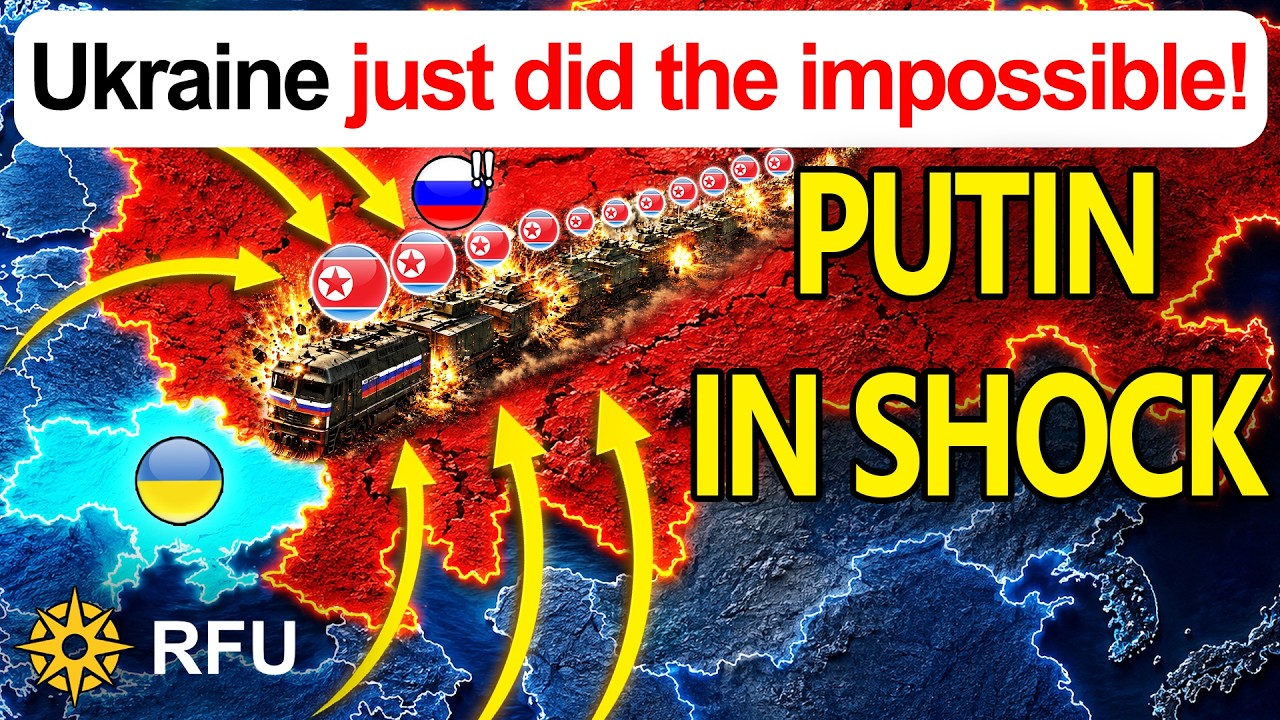
Today, Ukrainian army sources revealed a reported sabotage operation against a Russian military train carrying North Korean weapons that was targeted around six thousand kilometers from the frontline. According to Ukrainian military sources, simultaneous explosions destroyed a train transporting KN-Twenty-Three and KN-Twenty-Four ballistic missiles together with railcars loaded with artillery ammunition on the Trans-Siberian Railway. The attack occurred geographically much closer to North Korea than to Ukraine itself, and the resulting detonation destroyed the train, devastated part of the surrounding railway infrastructure, and halted traffic along the affected section. Official confirmation from Ukraine’s Main Intelligence Directorate has not yet been released, but once confirmed, this would rank among the deepest Ukrainian operations conducted inside Russian territory.
According to operatives within Ukrainian intelligence circles, the operation was preceded by a lengthy intelligence effort. The reported shipment was allegedly tracked from the vicinity of the North Korean border as it moved westward across Russia. Such an operation would have required establishing the train’s timetable, identifying where it would slow down, and selecting terrain where repairs after an attack would be particularly difficult. Ukrainian operatives have also needed to determine exactly which convoy contained the strategic cargo before committing valuable assets. Local assistance cannot be ruled out, as some remote Russian regions have long complained of economic neglect, potentially making discreet cooperation with outside intelligence services more feasible. Ukrainian agents would have also exploited the well-known corruption among the Russian administration, as such officials with access to railway schedules or cargo manifests could be bribed to reveal when a valuable shipment would pass a specific location. According to the reports, remotely controlled explosive charges were allegedly placed beneath the railway tracks and near critical points of the train before being detonated as it entered a difficult section of the line. Choosing such terrain aims to maximize destruction while making restoration substantially more complicated.
The effects of the explosion were dramatic, as they triggered a chain reaction that detonated the missile warheads and the accompanying ammunition cargo. The KN missiles carry a warhead weighing roughly five-hundred kilograms, meaning even a single detonation is capable of causing severe destruction. The exact number of missiles reportedly aboard the train has not been established yet, but the combined explosion reached the equivalent of dozens of tons of TNT, excavated a crater more than fifteen meters deep, and completely incinerated both the locomotive and the convoy. Burning fragments from solid-fuel rocket motors ignited surrounding vegetation and railway infrastructure.
The consequences extend well beyond the destroyed shipment, even though a Ukrainian intelligence source stated that the objective was to ensure none of the missiles intended for attacks on Ukrainian cities survived the operation. However, the Trans-Siberian Railway is Russia’s main east-west rail artery, stretching roughly nine-thousand-three-hundred kilometers from European Russia to the Pacific coast and connecting industrial centers with trade routes toward China, Mongolia, and the Korean Peninsula. It carries tens of millions of tonnes of freight annually, making it one of Russia’s most important logistical networks. Disrupting even one section can create delays of up to several weeks while damaged track, electrical systems, and wreckage are cleared and repaired.
Overall, the reported sabotage represents a direct Ukrainian response to the expanding North Korean military assistance to Russia, which includes missiles, launchers for them, artillery shells, and personnel for both the delivered systems and infantry. Destroying a huge single shipment would deny Russia valuable weapons immediately, while simultaneously damaging the railway itself could delay subsequent deliveries, increasing the logistical cost of relying on long-distance military support from North Korea.

🔴 Our interactive news map: https://www.rfunews.com/map
🔴 Subscribe to unlock full access to the map + exclusive strategic insights: https://www.rfunews.com/pricing
Today, the biggest news comes from the Russian Federation.
Here, separatists have emerged again to stage a coup and try to secede from Russia. However, what followed was a brutal crackdown and forced exile, showing that only oppression can hold the country together now.
Recently, Alexander Ivanov, a former parliamentarian from Yakutia, initially built his platform around claims that the Sakha people lacked political and cultural freedom, framing issues of language and identity as evidence of systemic inequality. He escalated this position by publicly entertaining the idea of Yakutia’s secession and amplifying his message through symbolic gestures, including recorded statements at the Independence Monument, which recast a regional discourse into a more overtly political challenge to the Russian state. His activities moved beyond domestic advocacy as he began cultivating international visibility, using foreign media outlets, particularly in Turkey, to project his narrative outward and aligning himself with circles linked to Pan Turkist ideology. This shift effectively transformed his position from a regional political stance into one with geopolitical implications, raising concerns about external influence and coordination. Moscow’s response followed this escalation as Ivanov was designated a foreign agent and stripped of his parliamentary mandate. By persistently promoting narratives of oppression and advocating separation, he directly undermined national unity.
The central authorities must suppress these separatist ideas before they spread to other regions and political spaces. Because of the developments in Yakutia, Russia must act now to prevent further disruptions in other problematic parts of the country. Notably, the risk is far greater than Ivanov's remarks because now these ideas can quickly proliferate, and other regional politicians and activists can join him and declare their desire for more autonomy or full independence. If other separatists see that Moscow cannot assert dominance, they will be inclined to act while the government is weak and occupied with waging a war in Ukraine.
These separatist tendencies are not limited to Yakutia but can be observed across several regions of Russia, taking different forms depending on local history and demographics, which makes it harder for Moscow to control. In the North Caucasus, separatism has historically taken the form of armed insurgency, as seen when the Chechen Republic of Ichkeria declared independence, leading to prolonged and violent conflict before federal control was reimposed. By contrast, in Dagestan, the issue is less about a single unified movement and more about fragmented proposals reflecting the republic’s ethnic complexity, which diffuses separatist sentiment. Proposals range from creating independent ethnic entities to forming a unified Dagestani state. Further north, in the Volga Federal District, movements are generally less militant and focus more on cultural autonomy and political rights among Turkic and Finno Ugric populations, indicating a more subtle approach compared to complete cessation or military action.
The drivers behind separatist sentiment across Russia’s regions include economic disparities, control over natural resources, and unequal burdens in military mobilization. Each region carries its own historical grievances and sources of tension with the central government. In many ethnic republics, where non Russian populations form majorities or significant minorities, separatist narratives are often rooted in nationalism, cultural preservation, and long-standing historical memory. Concerns about the disappearance of local languages and traditions intersect with perceptions that resource rich regions are economically exploited, with wealth extracted but insufficient reinvestment into local development or poverty reduction. Military mobilization has further intensified these grievances because it has been disproportionately affecting poorer, rural, and minority communities. As a result, certain ethnic groups, such as the Buryats and other indigenous peoples of Siberia, have appeared in casualty figures at rates exceeding their share of the overall population.
💎 Special Offer: starting from just $4.99! Get 50% OFF full access to the map + exclusive strategic updates: https://www.rfunews.com/pricing
In this video, we will analyze Russia’s recent mechanized assault on Sloviansk.
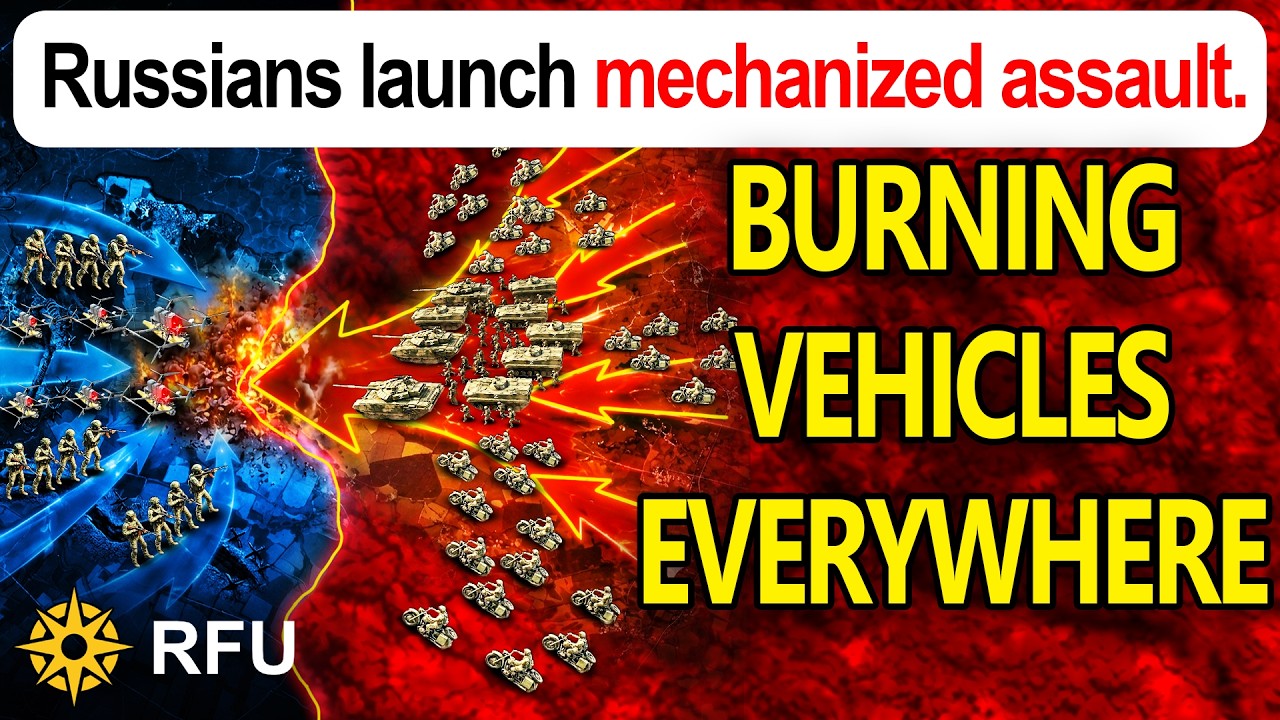
Here, Russian forces launched one of their largest mechanized assaults in months in an attempt to force movement on the Sloviansk axis. What followed left burning vehicles scattered across the battlefield and turned this attack into one of the clearest examples of how much was at stake in this push.
Russia’s goal here was to break through the Ukrainian forward positions covering the northeastern approaches to Sloviansk, especially in the Zakitne and Kryva Luka direction. These settlements matter because they form part of the outer defensive area shielding Sloviansk, so losing them would weaken the defense and open more favorable routes toward positions farther back. That is why Russia launched a larger mechanized assault here rather than relying solely on smaller infantry probes, as it was trying to force a breakthrough through the outer layer of the defense in a single push.
Russia tried to do that by sending two assault groups forward at the same time on separate routes, one toward Zakitne and the other toward Kryva Luka, in order to pressure the Ukrainian defense from multiple directions. This gave the attack a better chance of splitting Ukrainian attention and stretching drone coverage, preventing the defenders from focusing all their fire on one approach.
This attack plan was meant to give the Russians several advantages during the advance. Russians also committed motorcycles to reduce dependence on roads and tight formations, allowing the Russians to cross exposed ground faster without bunching into an easy target. The Russians also sent several tanks and BMP to their assault, meant to suppress Ukrainian positions and absorb fire while lighter elements pushed forward. In theory, that made the assault more resilient than a single dense column, because even if one vehicle was hit, other elements could still keep moving, giving the Russians a better chance of achieving their goal.
However, the main weakness of this Russian assault was that both groups still had to cross exposed approach routes into a defended sector. That allowed Ukrainian defenders to track the advancing elements early, slow them on the route in, and then strike vehicles and isolated groups as the assault began to break apart. Instead of arriving as one concentrated force, the Russian assault was reduced to smaller fragments that could be destroyed separately.
The footage shows exactly how that breakdown happened in practice, as Russian motorcycles, transport vehicles, and BMP move along roads and tree lines, but instead of building into one continuous assault, those elements appear increasingly separated as they come under fire. FPV drones strike BMP and other vehicles while they are still moving, catching them before they can reach cover or support the rest of the advance. In several moments, the assault appears to lose tempo completely, with individual vehicles destroyed on the route while other elements are forced to keep moving past wrecks or stop in exposed positions. Abandoned motorcycles and vehicles were hit after parts of the assault had already stalled, suggesting a loss of momentum before the attackers ever reached the line. By the time burning wrecks begin to accumulate along the approach, the footage shows that the real battle was no longer at the point of breakthrough, because Ukrainian defenses had already turned the route into a kill zone and broken the assault apart in motion.
Overall, the failed Russian assault shows that the Russian command is still trying to break the approaches to Sloviansk through larger mechanized attacks rather than relying only on small infantry group infiltrations. At the same time, Ukraine has shown that it still has the reconnaissance and strike coordination needed to respond to large-scale assaults in this sector. That means Russia may continue launching attacks of this kind, but each failure will make this method harder to sustain. If these assaults keep failing after detection, Russia will likely shift toward smaller and less visible attacks, because once Ukrainian reconnaissance spots a larger mechanized force, Ukraine can hit it quickly before it achieves anything meaningful.

💎 Special Offer: starting from just $4.99! Get 50% OFF full access to the map + exclusive strategic updates: https://www.rfunews.com/pricing
Russian convict soldiers have started to revolt against the very commanders responsible for forcing them into suicidal assaults, with some even executing officers and elite drone operators involved in killing their own men. The first incident involved a Russian soldier who was captured by Ukraine and admitted that he had murdered his own company commander during an earlier deployment. According to his testimony, constant abuse led him to shoot his commander and burn the body to hide the crime, although he was eventually arrested and sentenced to eight years in a maximum-security prison. Despite killing his commander, the Russian Ministry of Defense allowed the convicted commander-killer to leave prison after signing another military contract and sent him back to the front. By doing so, Russia knowingly rearmed a soldier who had already proven willing to kill his own officers, showing that finding more recruits had become more important than protecting its own chain of command.
The danger of this policy was not hypothetical, as another prisoner recruit soon turned his weapon against some of Russia's most valuable personnel. A Russian soldier who had previously served a twelve-year prison sentence before joining the army joined the Rubikon drone unit and opened fire on fellow troops in the Kharkiv region. The shooting killed six soldiers and wounded two others, including highly trained Rubikon drone operators. These specialists are difficult to replace and are deployed to Russia's most important offensive sectors. Their deaths represented that convict recruits are beginning to target the very personnel responsible for enforcing Russia's brutal system of control. Since Rubikon drone crews are frequently used to direct strikes against Russian soldiers attempting to retreat or surrender, they have become natural targets for troops seeking revenge against those killing their own comrades.
Another similar case occurred last year in the Zaporizhzhia region, showing a recurring response to coercive discipline and problems that Russians clearly do not try to solve. Here, a Russian soldier shot and killed the commander of his grenade launcher platoon while also wounding a sergeant. Together, these incidents reveal the same underlying problem as Russia is filling its ranks with convict recruits while relying on abusive commanders to control them through fear, beatings, and executions. Eventually, some of those soldiers stop obeying and instead turn their weapons against the officers and comrades enforcing that terror.
The reason this violence keeps emerging is that many Russian soldiers no longer want to fight but have virtually no safe way to escape the battlefield. Refusing orders can result in imprisonment, severe beatings, or execution. Desertion is prevented by military police and blocking detachments stationed behind frontline units, whose purpose is to arrest fleeing soldiers and force them back into suicidal assaults. At the same time, Russian drone operators monitor their own troops and direct artillery or FPV drone strikes against soldiers attempting to surrender to Ukraine. The goal is to convince everyone else that neither retreat nor surrender offers any chance of survival. Trapped between Ukrainian positions ahead and execution from their own side behind, some soldiers eventually decide that the only way to survive is to eliminate the men enforcing those orders.
Interestingly, Ukraine has recognized that these blocking detachments are essential to keeping unwilling Russian soldiers in combat and has begun deliberately targeting them. One recent strike destroyed a Russian military police armored vehicle belonging to a unit that had been heavily reinforced across Russian-controlled Donetsk specifically to prevent desertion. This reflects a broader Russian problem as constant suicidal assaults reduce morale, collapsing morale increases refusals and desertions, and those desertions force Russia to deploy even more blocking units to maintain discipline.
As Ukrainian strikes destroy military police vehicles, kill blocking detachments, and disrupt their patrols, gaps begin to appear in this system of coercion. Those gaps make desertion easier, and successful escapes can quickly encourage others to follow. Russia is then forced to divert additional soldiers, vehicles, and equipment away from combat operations simply to police its own troops. Meanwhile, the commanders, military police, and drone operators enforcing discipline become increasingly exposed as they are hunted by Ukraine and also by the Russian soldiers they are trying to control.

🔴 YOU ARE MISSING HALF OF OUR VIDEOS! Subscribe to unlock all out reports and support our work: https://www.youtube.com/channe....l/UCcNB1tZYpeDetqCad
Today, the biggest news comes from the Pokrovsk direction.
Recently released footage by the Ukrainian Rubizh brigade shows a small stretch of land filled to the brim with killed Russian soldiers. The brigade states that Russian forces have tried to infiltrate the area in small groups but are consistently failing to make any progress. The unit reports that in this small area alone, they have killed over one-hundred enemy Russian soldiers.
For the past six months in this sector, Russians have been repeatedly trying to penetrate deeper into Ukrainian lines and again break through the Ukrainian defense line. Doing so would move them closer to surrounding Dobropillia from the east, the last major Ukrainian stronghold in Western Donetsk. After failing to break into Dobropillia from the south directly, Russians see outflanking as their only viable option left, outside of overcommitting all of their reserves and leaving nothing left to take advantage of the breakthrough.
However, in the video shared by the Rubizh brigade, we can see exactly why the Russians are failing here on the flanks. The footage shows that the killed Russian soldiers are piled up against lines upon lines of concrete blocks and razorwire defenses. Interestingly enough, we can see in the footage that in trying to cut open a path through the razor wire, Russian soldiers themselves created a narrow corridor that Ukrainians were able to concentrate their fire onto; inadvertently creating the exact kill zone that resulted in the disastrous losses for the Russians.
Namely, Ukrainians have constructed an extensive defensive line made up of engineering obstacles placed in depth. In some places, the line reaches as deep as six layers of barbed and razor wire, dragon’s teeth, and anti-tank ditches. All of these defenses are able to counter both Russian armored and infiltration assaults, meant to slow down and delay enemy movement to allow Ukrainian defenders the time to eliminate all of the threats. These areas where Russian movement is slowed down and concentrated to one spot are then exploited to the maximum effect and turned into killing fields. Footage shared by the Russian side last month already shows around one-hundred Ukrainian drones waiting in ambush along only a small stretch of road. These drones lay in ambush along viable and known Russian infiltration routes in standby mode to save battery, coming into action and striking the enemy soldiers once they come into view.
With the Azov Corps commander taking full responsibility for this sector, these Ukrainian tactics are being implemented with increasing frequency. Notably, Ukrainian forces report that when these tactics are applied correctly, they allow them to eliminate sixty Russian soldiers for every Ukrainian soldier lost in combat. These devastating losses in exchange for minimal territorial gains are gradually wearing out Russian reserves and combat capabilities, undermining Russian offensive posture and momentum as well as their defense. The undermining of Russian defensive posture through exhausting their manpower reserves is extremely important if we remember that currently the Skala assault regiment has been transferred to this sector, has been placed under Azov command, and is currently spearheading operations to unblock critical defensive positions in front of Dobropillia. Ensuring that Ukrainian defenses do not budge against Russian assaults ensures that Ukrainians have a secure staging ground to launch their counterattacks from, increasing the chances that Ukrainians will be able to turn the tide in the Pokrovsk direction as well.
Overall, Russians have failed to find a way into the Ukrainian fortress town of Dobropillia, and are losing hundreds of men in narrow chokepoints in trying to outflank it. Ukraine’s modernized engineering obstacles designed to counter exactly Russia’s most important tactics of mechanized assaults and infiltrations are proving extremely effective at holding the enemy at bay. As Russians are unlikely to admit that they are unable to advance, even more Russian reserves will be sacrificed in the Ukrainian kill zones north of Pokrovsk. As these losses accumulate to a breaking point, Ukrainians will be able to take advantage and retake the initiative in this sector as well, continuing a trend being seen in more and more places along the Ukrainian front lines.

💎 Help us expand the coverage! Subscription starts from just $4.99! Get 50% OFF full access to the map + exclusive strategic updates: https://www.rfunews.com/pricing
Today, the biggest news comes from the Kostiantynivka direction.
Here, on the western flank of the city, Russian forces just launched a massive offensive trying to break through Ukrainian lines and envelop the defenders from the west. Doing so would place Ukrainian ground lines of communication into the city under complete Russian fire control, and starting the battle for the city of Druzhkivka to the north. Unfortunately for the Russians however, the Ukrainian ninety-third mechanized brigade defending this crucial sector just released brand new footage that shattered any Russian hope of their offensive succeeding.
Geolocated footage shows how their drones are detecting Russian infiltrators moving toward their lines in massive numbers. Immediately struck by FPV kamikaze drones, these Russian soldiers stand very little chance in the wide open fields. Russians next tried armored assaults in the sector, moving large numbers of infantry rapidly inside of massive cages mounted onto the tanks. Ukrainians showed how they made quick work of these assaults, burning the vehicles and stopping Russians in their tracks. Russian infantry that managed to dismount found themselves in the middle of a massive kill zone, and heavy bomber drones carpet-bombed the tree lines with mortar rounds to ensure that no one remained to attack Ukrainian positions. Additionally, these heavy bomber drones were also equipped with singular but much more heavy explosive devices, able to penetrate through the roofs of buildings where Russians were sheltering in and turning them into ruins. Russians quickly shifted to a lower-visibility approach, filling pickup trucks with infantry and bags of supplies to allow Russian infiltrators to stay on position for as long as possible. Striking them in the open fields, Russian infantry once again had nowhere to run to as they were left stranded without any cover. Russian motorbike assaults soon followed, but intense Russian shelling of the fields here meant that the motorbikes had to stay on the asphalt to maintain any speed during their attack. This made them even more easy to strike, as FPV drones and artillery worked together to shell the unprotected assaults with shrapnel and blast waves. Even at night Russians tried to break through, but made a critical mistake by leaving their headlights on to evade obstacles on the road.
However, no defense remained impregnable, and a few Russian soldiers inevitably managed to evade detection and slip past the Ukrainian kill zone. Fortunately for Ukrainians, the ninety-third brigade houses skilled assault troops that conducted regular clearing operations of the settlements in the grey zone where Russian infiltrators could accumulate. Through this, Ukrainians were even able to push deeper into no-man's land, and repeatedly clear Russian underground positions and dugouts, preventing Russians from advancing through gradual consolidation. This critical component in modern warfare also resulted in a steady supply of surrendering Russian soldiers and important intel that Ukrainians were able to act on. This intelligence exposed unknown Russian infiltration routes, and allowed gaps in the line to be closed as soon as Russians found one. Russian electronic warfare also became increasingly countered, as the brigade is fielding a large number of fiber-optic-controlled FPV drones that do not need a wireless signal to the pilot, as can be seen from the coils of fiber optic wire exploding away from impacts. . This allowed Ukrainians to even strike in areas where signal strength had been exceptionally low due to terrain factors or damaged antennas. In the end, Russians have been completely unable for months to advance in the brigade’s sector of responsibility, and the western flank of Kostiantynivka continues to hold because of them.
Overall, the Ukrainian ninety-third brigade has shown itself exceptionally capable in the defense of Kostiantynivka. Preventing the encirclement of the city’s defenders, they have countered each and every one of the different tactics and assaults that Russians have thrown at them. Through their active defense and clearing operations, they have worked with their Azov brigade neighbors to fully clear over one hundred kilometers of Russian infiltrators. As the Russians cannot seem to break through their lines, their plans to reach and capture Druzhkivka by the end of the year is falling apart at the seams.